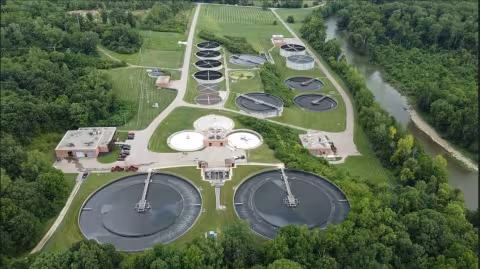
A publicly owned waste water treatment plant
Under Section 208 of the Clean Water Act MVRPC has the responsibility for reviewing and approving individual Wastewater Treatment Facility Plans and their associated Facility Planning Areas. On September 1, 2005 the MVRPC Board of Directors adopted two documents: the Areawide Wastewater Facility Planning Policies and the Guidelines for Facility Plan and Facility Planning Area Updates. These documents will guide the AFPSC and MVRPC staff's consideration of wastewater treatment plan updates. The Areawide Water Quality Management Plan is periodically amended to update the FPA's. MVRPC completed a full update of the 2011 AWQMP.
Facility Plans were originally developed by owners of Publicly Owned Treatment Works (wastewater treatment plants) in the late 1970s and early 1980s under the 201 Construction Grants Program. A Facility Planning Area (FPA) was delineated for each wastewater treatment plant that included the plant’s current and projected service area, as well as additional areas in which wastewater would have to be handled by other accepted means, i.e. on-site septic systems and package plants. Although the original FPAs were largely based on existing drainage boundaries, other features such as property lines, roads, and corporation boundaries were also used to establish FPA boundaries. Ohio EPA uses the FPA boundaries as primary criteria on which to base its decisions on whether or not to grant Permits to Install (PTI) for additional plant capacity or sewage collection infrastructure.
Each wastewater Facility Plan prescribed how wastewater would be managed in each Facility Planning Area and identified the Designated Management Agencies (DMAs) with those responsibilities. DMAs typically included the primary wastewater treatment plant owner, Health Districts for the management of on-site septic systems, and sometimes Counties that operated package plants. Facility Plans also described the type of wastewater treatment provided (primary, secondary, tertiary) and how the plant’s capacity was designed to meet the current and projected needs. Plans were usually based on 20 year population projections.
Policy and Guidelines Review in 2026
Throughout 2026 MVRPC staff facilitated a Working Group made up of Designated Management Agencies, including cities, counties, villages and public health districts to review and consider updated language for the Facility Planning Policies and FPA Update Guidelines. This was the first review of these documents since they were last approved by the Board of Directors in 2005. The Working Group compared the existing language with how the processes they govern are implemented in practice. They considered questions such as whether MVRPC should have “approval” authority for Facility Plans, and how annexations should factor in consideration of Facility Planning Area boundary updates. MVRPC staff are working to complete any desired policy updates, including public comment, and Board review and consideration by the end of calendar year 2026.
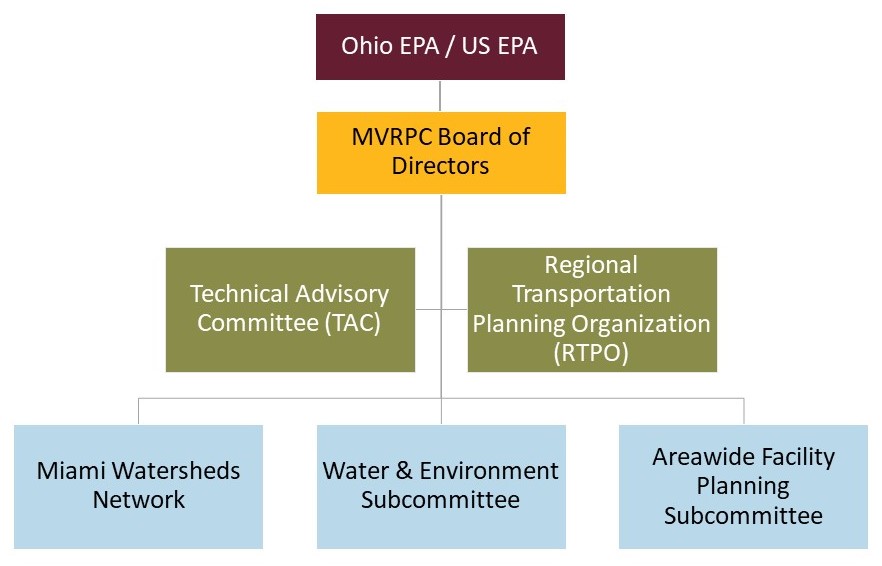
Areawide Water Quality Management Committee Structure
Recognizing the need to update old Facility Plans to reflect current conditions and incorporate new population projections, MVRPC developed a new process to review and approve Plan Updates, as well as changes in FPA boundaries. To accomplish this task the Areawide Facility Planning Subcommittee (AFPSC) was formed in Spring 2005 when the current policies and guidelines were adopted by MVRPC Board. The AFPSC will continue to meet to review wastewater treatment plan updates as needed.